December 13, 2013. Measuring vision is fundamental to visual-science research and standardization. Visual-acuity measurements are important in research and clinical practice, helping clinicians select correction with glasses, contact lenses or laser refractive surgery. The archive includes a PDF version of this article.
Historical references describe measuring visual acuity by the ability to distinguish two stars. Major changes in ophthalmology began around 1850. Eduard von Jaeger published reading charts in Vienna in 1854. In 1861, Franciscus Cornelius Donders, professor of physiology at Utrecht University Medical School, proposed a formula defining quality of vision and a standard eye capable of identifying letters subtending five arcminutes at 20 feet.
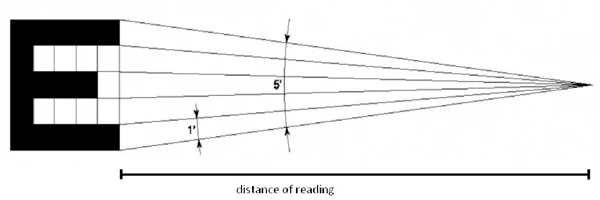
Figure 1 illustrates the principle: each optotype is built from five parts, each subtending one arcminute, with the whole optotype spanning five arcminutes at 20 feet. Donders chose Herman Snellen as collaborator and eventual successor. Snellen introduced his chart in 1862. The Donders–Snellen method became a worldwide standard and remained in widespread use more than 140 years later.
Advantages of digital systems: Distance calibration allows the examination distance to be adjusted, including in smaller rooms, whereas some wall charts and projectors require 20 feet, approximately 6 meters. Contrast can be adjusted in most digital systems; only some traditional systems provide this, sometimes at comparable cost. Software can be upgraded by installing a newer version. Digital displays do not require projector-lamp replacement or projector-optics maintenance. Portability makes it straightforward to move a display and mount it on a wall or table, whereas large backlit charts can be cumbersome. Digital systems, especially locally developed models, can be competitively priced.
Disadvantages: Digital systems can cost somewhat more than traditional charts, although the article presents the added capabilities as an investment. They can also be less straightforward to operate because the remote control exposes multiple software options.
The article compares the transition with film cameras gradually giving way to digital photography and anticipates a similar change in acuity testing. Readers were invited to discuss technical questions with the development team. The original product example was the team’s own digital visual-acuity system. This historical technical article was prepared by the development team; its original PDF is retained among the related resources.
Project resources
Brochures and manuals link to English EVOptica editions. Historical recordings, source citations and legacy interface screenshots may retain their original language. External archive links may no longer be available.