December 13, 2013. Valéria Mellaci de Carvalho defended a master’s dissertation at UFSCar’s Biotechnology Department, funded by the company at the time. Its title was “Development of a National Database for an Automated Instrument for In Vivo Visual-Field Measurement.” A PDF version of the article and the dissertation were offered in the archive.
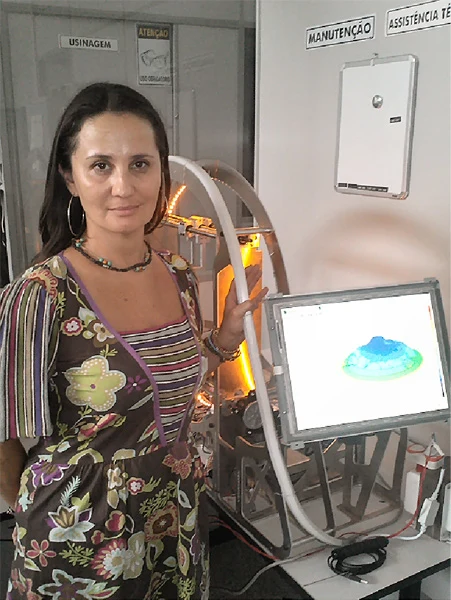
The engineering and R&D team had spent years developing a new perimetry system. Initially designed around LEDs behind the bowl, the instrument later adopted a projection-based architecture. Figure 1 shows the researcher beside the instrument during work at the company.
The project attracted interest because the instrument could be used to establish a fully Brazilian database, which comparable instruments did not provide. Funding included the company’s instrument and R&D facilities alongside UFSCar resources. The study reported that imported perimetry databases underestimated sensitivity in the Brazilian population by approximately 3 dB. On the article’s stated logarithmic scale of 0–40 dB, it characterized the discrepancy as potentially important for identifying early disease such as glaucoma. These are the findings and interpretation reported in the historical article.
The public–private partnership was unusual because the student spent half her time within the company. Valéria, by then a biotechnology master’s graduate, explained that the arrangement provided infrastructure and equipment unavailable at the university and could serve as an example for future students.
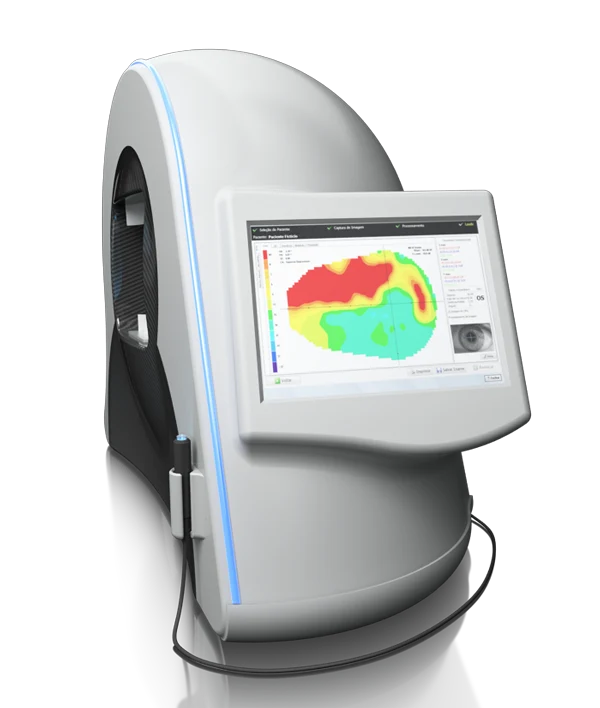
The new database was company intellectual property and was intended for the next instrument version, which the source text described as expected in mid-2013. Figure 2 shows the assembled VON instrument. The article contrasted its Brazilian database with databases in instruments such as Humphrey that were based on Anglo-Saxon populations.
Other planned features included external blue LEDs indicating examination completion, a joystick with a blue LED, Windows software offering the examination types available on Humphrey, and nationwide service and warranty at that time. The article linked to the VON product page, a Lattes CV at buscatextual.cnpq.br/buscatextual/visualizacv.do?id=K4214024E9, and a downloadable PDF of the dissertation. These historical product and service descriptions do not constitute a current sales offer.
Project resources
Brochures and manuals link to English EVOptica editions. Historical recordings, source citations and legacy interface screenshots may retain their original language. External archive links may no longer be available.